
Morgan Bassichis May Be a Solo Performer, but They’re Never Alone
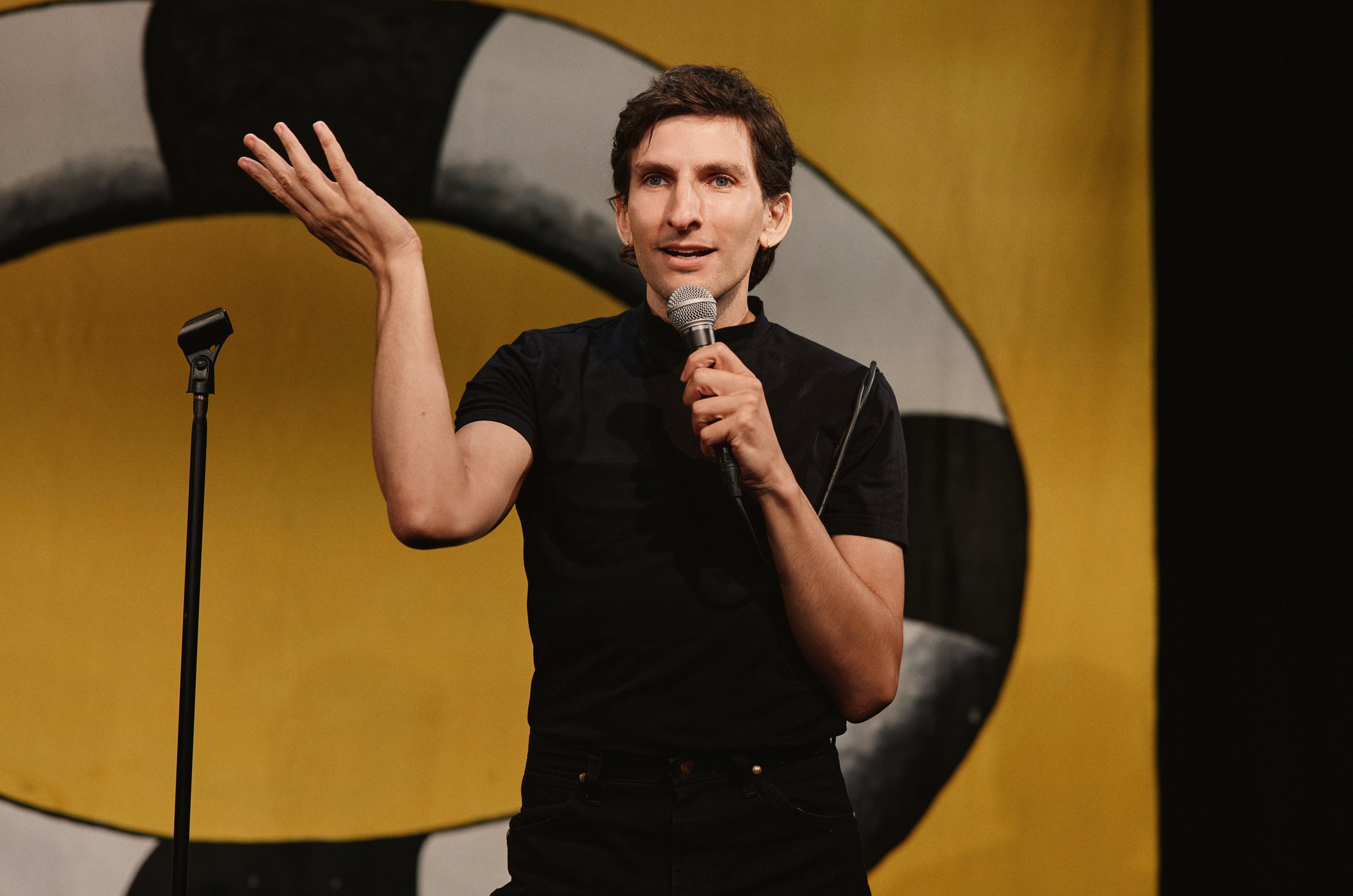
Photo by Emilio Madrid.
For the last three years, performer and writer Morgan Bassichis has been honing their obsession with the late comic Frank Maya, who died in 1995 from complications from AIDS. In their solo performance, Can I Be Frank?, Bassichis is borrowing Maya’s monologues and delivering his jokes to a contemporary audience. A chance encounter with Maya’s brother introduced Bassichis to his work, and though Bassichis had never heard of him before, they felt an immediate connection to the comic’s high-energy delivery and biting themes.
But Bassichis’s show isn’t simply a rehash of borrowed material; it’s a revelry in the queer canon and an exploration of Bassichis’s contemporary identity, both as a performer and a queer person in the wake of artists like Maya. “Immediately when I encountered his work, I felt a real resonance with my own — and this delicious sense of how derivative I am,” they say. “Part of what the show is, is reclaiming the idea of being derivative and not as a pejorative, but as an accurate description of what it means to be a person or an artist.”
In parroting Maya’s work, between long stretches of original material, Bassichis is engaging with Maya in a part-seance, part-duet, evoking Maya as part of an archive of material and situating themself alongside him, building on decades of queer performance art. Situating oneself among one’s history is a common theme in the genre, which Bassichis suspects goes hand in hand with the queer struggle for belonging. “I think we want family history,” says Bassichis. “I think we want to know that we come from somewhere. When we get into trouble as queer people obsessed with the archive is when we don't acknowledge our own ego in that search. When we're looking for others, we're also looking for ourselves.”
The tension in Bassichis’s work, then, comes from the desire to be both one of many and singularly unique at the same time. The push/pull is evident onstage as they fight with a long, unwieldy mic cord that holds them back, whips them forward, and ties them up in knots. “I sometimes think about the mic cord as kind of like the umbilical cord between the generations of solo performers,” says Bassichis. As they monologue in both their own words and Maya’s, they vacillate between “wanting to be seen and wanting to be in community; wanting to be of service and wanting to get credit.”
Even landing on Maya as a muse toys with that duality. Though he was on the precipice of fame towards the end of his life, Maya died before he could break through to the mainstream. He’s not well known. His name probably isn’t what’s selling the tickets. And that’s just fine with Bassichis. “It's not so much that Frank is more important or even more talented than any number of artists from that period,” they say. “In fact, him just kind of getting to be himself and one among many is actually very compelling to me.”
It dovetails nicely with the notion that though Maya — and many comedians like him — died too soon, he still left plenty behind to play with. “We are living in the impact of their artistic contributions,” says Bassichis. “The impact of downtown queer performance, of the ballroom scene, of so many queer and trans cultural spaces made all of us possible.”
It’s within that interconnectedness that Bassichis’s message hits the hardest. Though they take tons of inspiration from Maya, they also invoke a history of both queer solo performance and the devised work of lesbian feminist performance of the 80s and 90s. “The lineage of queer performance art that I really feel connected to,” says Bassichis. “They insisted that even if there's one person on stage, it's never just one person on stage. The idea of the solo performer kind of folds in on itself and challenges the idea of there being such a thing as an individual.”
While the ghost of Maya is the obvious “other” onstage, Bassichis also directly engages with their stage manager, Gloria Gomez, not to mention the audience, who become scene partners through a sort of reverse-heckling and crowdwork. It’s all in the name of queering the notion of solo performance and interrogating its very nature. “I think there is a kind of weird masculinist white hetero thing, the idea of an individual as an original and a genius — instead of the idea that even when there's one person on stage, we're part of constellations and we're made of lots of people,” says Bassichis. Still, they want you to know that they’re out there doing it for themself, too. “I find solo performers kind of sweet because we are just honest about our desire to be seen and applauded and adored.”