
Chris Grace is Laughing at Death, and He Wants You to Join Him
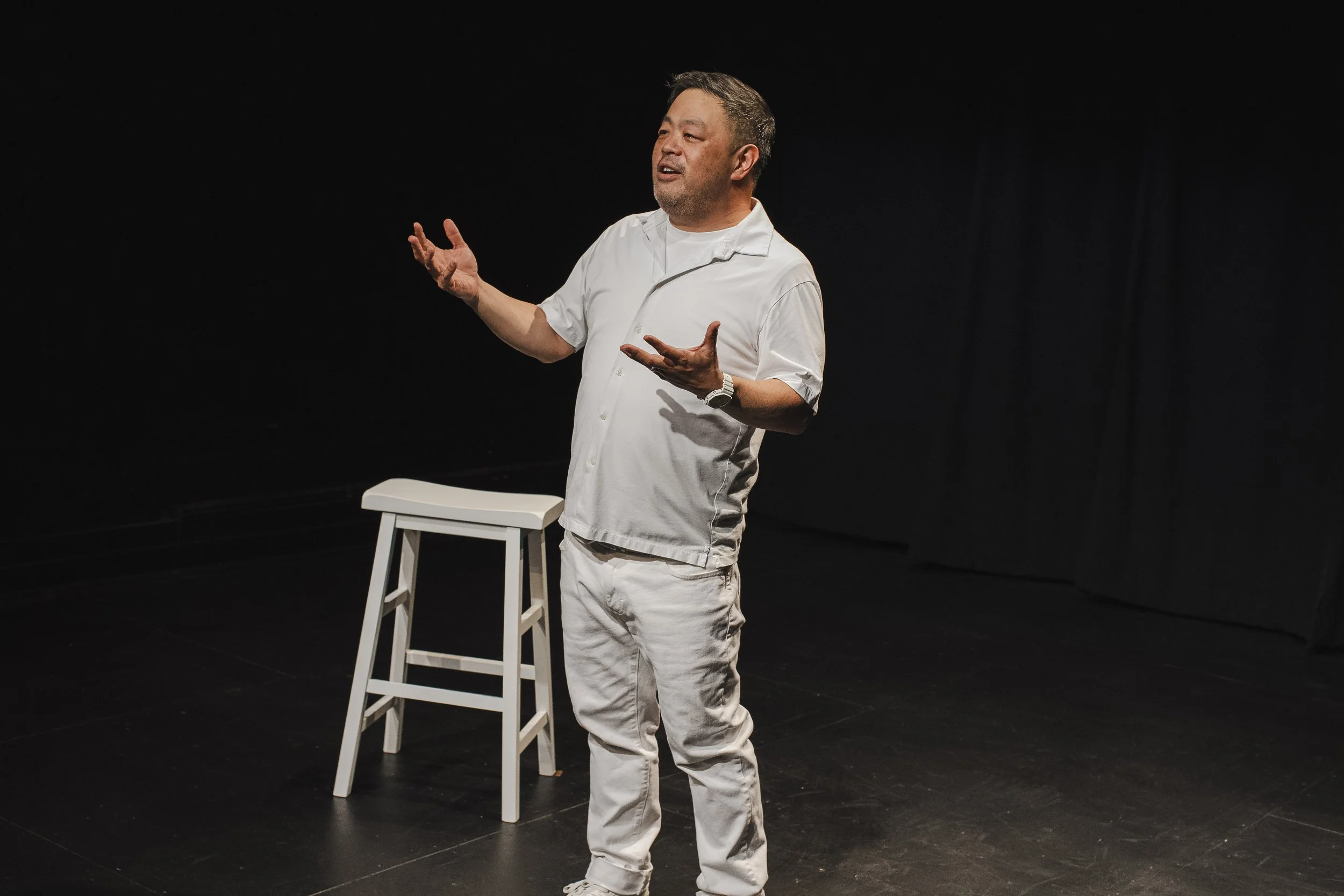
Photo by Marcus Middleton.
Chris Grace is a comedian, so naturally he’s decided to write a comedy about the deaths of his parents, two siblings, and his partner.
If you’re familiar with Grace’s work, this foray likely isn’t a shock. It’s certainly not his first time tackling heavy subject matter through the lens of comedy. In his previous solo show, Chris Grace: As Scarlett Johansson, he delved into themes of race, identity, and Hollywood casting politics. The Superstore and Dropout alum’s MO is using comedy to interrogate difficult subjects, not escape them.
His latest piece Sardines (A Comedy About Death) is running in repertory as part of New York Theatre Workshop’s In the Bricks Festival, a slate of vulnerable and deeply personal solo performances. Grace’s tangle with grief certainly fits the bill, asking questions about the value of humor in grief and whether making art about it actually helps.
And while Grace may never find a straight answer, his exploration yields an evening of gallows humor, existential dread, and Rihanna’s 2007 smash hit Don't Stop the Music. We sat down to talk about all of it and more. Our conversation has been edited for length and clarity.
This show's subject matter is right there in the title: Sardines (A Comedy About Death). Did you do that to serve as a warning to audiences about what they’re getting into?
CG: It works in a couple directions. It serves to give you a little bit of hope that you might have a good time when you come to the show. But also that I am a little bit irreverent throughout the show. So it prepares you for that too.
You're getting deep and dark into the nitty gritty of your own personal experiences with grief. How do you make it funny and not torture yourself every night?
CG: It's almost become a bit of a ritual. There’s a bit of therapy to performing the show now. I actually enjoy doing it. I think it's the moment of sharing the experience with the audience. That connection feels good to me. There's a couple of particular moments in the show that I really enjoy sharing, and I enjoy the feeling of communion with the audience.
Having engaged with audiences of the show for a while, what kind of person is drawn to this piece? Is it people in the grief club or people trying to understand it as an outsider?
CG: I've definitely had people in the grief club. Last night, I had someone whose mother just died two weeks ago come see the show. But I think anybody that's wrestling with the void — who has thoughts about what that mystery is — seems to be drawn to it. And also people that like my comedy in general.
There's certainly a metatheatricality to Sardines. The fourth wall does not exist. You directly address the audience a lot, and there are a few moments in the show where you say, “These are the jokes that my family said are too dark for the show.” Yet, of course they're still in the show. Why place the humor on the edge? Is that surprised guffaw the best way to break the ice for people?
CG: That's my taste. People that have experienced death in their lives have had that experience of gallows humor. I lived there already even before my experiences of grief. So it is my particular sense of humor, but I do think it's also representative of a lot of the humor in grief. Almost everybody that's gone to a funeral has had one moment in the funeral where they shouldn't be laughing, but are.
There's a lot of incongruous moments as you go through a period of grief, and there's a lot of very surreal things. My experience has been that you almost feel functionally insane. You've been alive long enough that you know how to simulate being a human being, but it feels a little bit like you're putting on a performance.
You're a comedian by billing, by trade, by training, but this is anything but classic standup. It’s also not your first time addressing a challenging topic. You discussed identity and race in Chris Grace: As Scarlett Johansson. Why are you drawn to such heavy subject matter?
CG: Mostly because I end up not being able to do anything else. Even with the show that I'm working on right now for Edinburgh Fringe this year, which is intended to be an hour of standup, I find heavier stuff creeping in. I think it's just because that's where my brain goes.
Part of it is that I don't think I'm that great at just doing something light and funny that doesn’t have anything more to it. I think there are other people that do that way better than me. I don't know if it's a factor of my experience, my life, or my age, but I do feel like I'm pretty good at talking about some of these subjects in a way that people are interested in. From a pragmatic point of view, there aren't as many comedy shows about these things. So sure, I'll talk about them.
Does situating it as comedy ever make it a harder sell? Are audiences ever reticent to go there with you?
CG: I think it can result in people being a little slow to warm up to it, but I constructed the show in a way that's not really expecting you to be slapping your knee in the first five minutes. Also I'm not really going for a quantity of laughs the way that might be expected in a pure stand-up show. I think there are probably fewer laughs in this show than a typical stand-up show, but I want people to feel that they're coming from a deeper, richer place.
I think some of it is also that I've lived with the piece a lot longer now. Because I've been with the piece for a couple of years now, I think I'm pretty confident in letting the moment live each night. Because I wrote it, I'm happy to go off script whenever I want to. That is always on the table for me. That is one of the ways that I'm not presenting a prepackaged experience for you. It's happening in the moment every night.
There's a couple of moments that really do involve the audience that are naturally different every night.
Yeah, I want to talk about the moment in the show where you ask the audience to help you recreate Don’t Stop the Music by Rihanna each night. Where did that come from? Why were you like, “Let's make the audience sing Rihanna right now?”
CG: One factor is that at Edinburgh Fringe, where I debuted the show, there's a lot of audience participation. So in the context of Edinburgh, that section is not that unusual. But it was a little bit to wake up the audience. The more I could strengthen their participation in the show and get them to use their imagination, the more the show feels like a bit of a magic trick.
I also just thought it would be fun. It’s crazy because there are some nights where it goes really well in terms of how well we recreate the music. Sometimes, especially if there's an entire section that has never heard of Rihanna, it's been a disaster, but it's so funny. It's very enjoyable whether or not it goes well.
You have this tendency within your shows to make yourself a character within the piece, especially in Chris Grace: As Scarlett Johansson. How do you situate yourself as a character in Sardines when you're getting more personal than maybe ever before?
CG: I think you're right. I think this is the least distance between myself and the character. Actually, from my perspective, there is none. There is no distance between me being there on stage and being the character. However, I think with the artifice of theater, it’s still not zero.
This feels like a very intense walk through very traumatic events, and it is. However, it's the 200th time I've told this story in front of an audience. It would be physically impossible for me to experience the same traumatic energy every single night. It would be unsustainable for me to feel that every single night. Through that process, there's inevitably going to be a little bit of distance inserted.
Your husband, Eric Michaud, is directing this piece. He also features as a character in the narrative as you discuss his journey with cancer. What does the dinner table conversation look like as you've been putting this together?
CG: It actually hasn't been that different from other projects that we've done. We've worked together before [on Chris Grace: As Scarlett Johansson and more]. The only thing is that because we both have pretty dark senses of humor, we do talk about the fact that he has to stay alive or I have to rewrite the end of the show.
One of the big questions that you ask in Sardines is, “Does making art actually help with any of this?” After performing this so many times, do you have an answer?
CG: What's so funny is that I have so many people come up after the show that tell me, “Yes, the answer is yes! Art helps, art helps!” I reliably have lots of people telling me after the show that the answer to that question is yes.
I think the jury's still out.
In our current society, it feels a little futile sometimes. For example, we've heard many, many times in art that racism is bad. But has that actually moved the needle in terms of racism or xenophobia or transphobia or any of that kind of stuff? But I've expanded my timeline. Maybe there are things that move the needle that don't necessarily happen within my mom's lifetime or my lifetime or my niece's lifetime.
But I do have visceral proof that it is helping individual people when they come see the show because they feel very moved by the show, and that is really gratifying. But on the grand scheme of things, I don't know. It's interesting to me to not have an answer to that question. It's almost more interesting for me to keep trying to make art and see if the answer is yes or no.
I think making the art to answer that question is more interesting than coming into it with a sense of art universally being a good thing and always helping. I think that is reductive and probably points me toward less interesting work.
Sardines (A Comedy About Death) is running through June 14 at New York Theatre Workshop